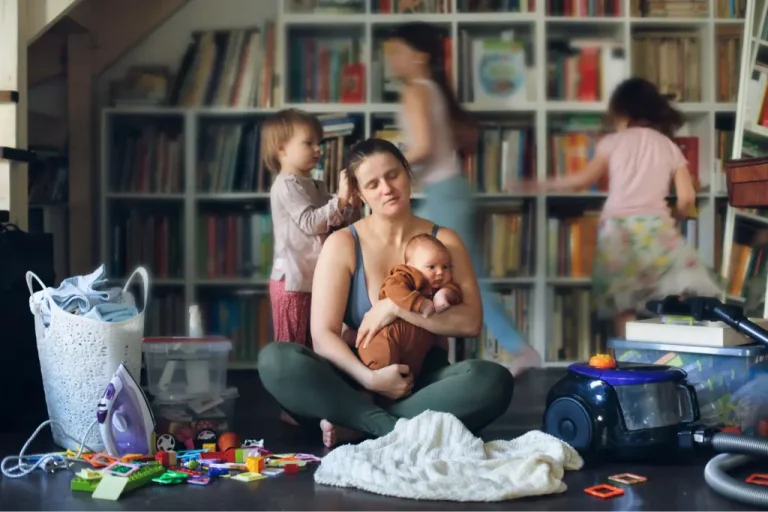
In the quest for conscious parenting, many parents in the USA and Canada strive to be the “perfect” emotional support system. We want our children to feel heard, validated, and happy. However, there is a subtle, dangerous line between being an empathetic parent and becoming an emotional overgiver. When we cross this line, we stop being a “guide” for our children’s emotions and start becoming their “absorber.” We take on their frustration, their sadness, and their anxiety as if they were our own, leading to a state of chronic depletion and internal chaos.
In the framework of parent wellness, emotional overgiving is often a trauma response disguised as virtue. It is the belief that if our child is unhappy, we have failed. This mindset not only leads to parental burnout but also inadvertently prevents our children from developing the very resilience they need to navigate a complex world.
The anatomy of the emotional “Fixer”
Why do we feel the desperate need to fix every one of our child’s discomforts? For many, the answer lies in our own inner awareness. If you grew up in a home where big emotions were met with anger, dismissal, or a parent’s own breakdown, you likely learned that “negative” emotions are dangerous. Now, when your child cries or feels frustrated, your nervous system interprets their distress as a threat to your own safety.
You are not fixing their feelings for them; you are fixing them so you can feel okay again. This is known as emotional enmeshment. Instead of standing on the shore while your child learns to swim through a wave, you jump into the water and try to hold the wave back. The result? You drown in their experience, and they never learn how to stay afloat.
The hidden toll of over-providing
When we over-provide emotionally, we are essentially saying to our children: “I don’t believe you are strong enough to handle this feeling.” Over time, this can lead to:
Parental Exhaustion: You are carrying the weight of two (or more) emotional lives. This is a primary driver of the “numbness” or “shutdown” we often feel.
Childhood Fragility: Children learn that they need an external “rescuer” to regulate their internal state. They lose the opportunity to build the “muscles” of frustration tolerance.
Resentment: Eventually, the parent who gives too much begins to resent the child for “taking” so much, even though the parent was the one who volunteered to carry it.
Awareness box: the “mirror vs. sponge” reflection
The next time your child is having a “big” moment, take a breath and ask yourself: “Am I being a Mirror or a Sponge?”
A Mirror reflects the emotion: “I see that you are really disappointed right now. It’s okay to feel that.” You remain separate and grounded.
A Sponge absorbs the emotion: You feel the disappointment in your own chest, you start racing to fix it, and you feel personally responsible for their mood.
True parent wellness is about learning to be a Mirror present and empathetic, but anchored in your own emotional skin.
Building healthy emotional boundaries
Boundaries are often misunderstood as “walls” that keep people out. In reality, a boundary is a “fence” that defines where I end and you begin. In parenting, boundaries are the foundation of a healthy attachment.
Validate without Rescuing: You can offer deep empathy without changing the outcome. “I know it’s hard to stop playing, and I’m here while you’re sad, but it is still time for bed.” This honors the child’s feeling while maintaining the parent’s boundary.
Allow the Struggle: Resilience is built in the gap between a need and its fulfillment. If we close that gap immediately every time, we rob our children of the chance to discover their own strength.
Check Your Internal Why: Before you rush to soothe your child, pause. Is your heartbeat fast? Are you feeling anxious? If so, regulate yourself first. A child cannot calm down if they feel their parent is “panicking” because of their sadness.
Moving toward interdependence
The goal of inner work is to move from “Enmeshment” (I am you) to “Interdependence” (I am me, you are you, and we are connected). When you stop overgiving, you create space for your child to grow into their own person. You also reclaim the energy you’ve been spending trying to control the uncontrollable: someone else’s internal experience.
This shift requires a radical acceptance of “negative” emotions. Sadness, anger, and disappointment are not problems to be solved; they are parts of the human experience to be felt. When you allow your child to feel these things without trying to “fix” them, you are giving them the ultimate gift of trust. You are telling them: “You are capable. You are resilient. And I am right here with you.”
The impact on parent wellness
When you stop being an emotional absorber, you will likely feel a strange sense of “emptiness” at first. This is normal. It is the sound of your nervous system finally getting a break from the constant noise of other people’s needs. This space is where your own parent wellness can finally take root. You will find that you have more patience, more clarity, and most importantly more joy.
However, for some parents, the habit of overgiving is so deeply ingrained that when they finally stop, they don’t feel “peace.” Instead, they feel a terrifying silence. When we have spent a lifetime ignoring our own internal signals to focus on others, the sudden removal of that focus can lead to a state of profound emotional flatness.
Conclusion
Reclaiming Your Sovereignty
The journey from being an emotional sponge to a grounded mirror is not about caring less; it is about caring sustainably. By stepping back from the role of the “Fixer,” you stop viewing your child’s emotions as a fire to be extinguished and start seeing them as a landscape to be explored. This transition protects your own mental health and empowers your child to own their emotional world. True connection thrives in the space between two whole individuals, not in the collapse of one into the other. Embracing this healthy distance is the highest form of love one that fosters resilience in them and restores peace in you.
Emotional maturity is not innate. It is built slowly, through experiences, relationships, and moments of self questioning. It is the ability to recognize and manage one’s emotions without being overwhelmed by them. It influences the quality of our relationships, our mental health, and the way we respond to everyday challenges. In a society where speed…
Some days, motherhood feels loud long before anyone raises their voice. The toys scattered across the floor. The constant questions. The background noise of everyday family life. The endless stream of decisions that need to be made. Many mothers describe these moments by saying they feel overwhelmed, but sometimes the experience goes deeper than stress…
For many parents, the journey of raising a child is often focused outward on schedules, nutrition, education, and behavior. We spend countless hours researching the best ways to nurture our children’s development, yet we often overlook the most critical factor in their well-being: Our own internal state. Parent Wellness is not about spa days or…
Stress in children rarely announces itself clearly. Here is what parents need to watch for and how to respond with calm and confidence. Most of the time, stress shows up in small changes that are easy to miss at first. A child may become quieter than usual. Another may snap at siblings over nothing. Some…
many parents struggle with boundaries, not because they do not care, but because they care deeply. they want to be present, supportive, and emotionally available, yet they often feel overwhelmed, stretched thin, and quietly resentful. boundaries are frequently misunderstood as rules, distance, or rigidity. in reality, healthy parental boundaries are about self-respect, emotional clarity and…
Throughout this series, we have explored the invisible forces that drive our reactions as parents: the childhood wounds, the sudden floods of emotional flashbacks, the heavy fog of guilt, the exhaustion of overgiving, and the protective silence of numbness. Now, we reach the culmination of this journey. We must look at the “Big Picture” how…