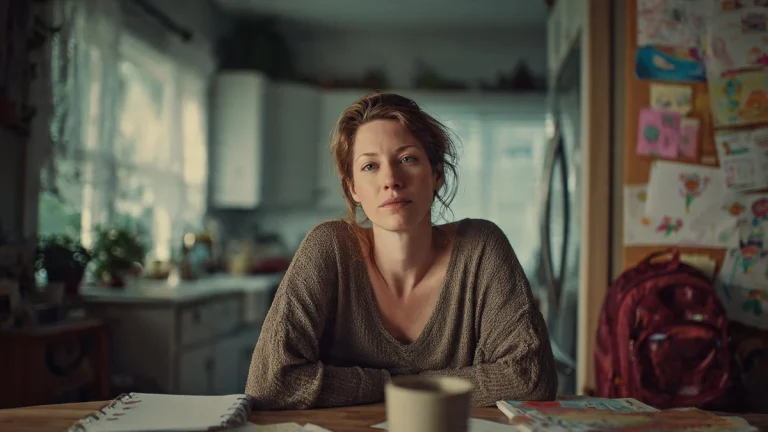
Parenting is often described as a journey of teaching, guiding, and nurturing. However, for many parents in the USA and Canada, it feels more like an emotional obstacle course. You might find yourself reacting with intense, white hot anger when your child refuses to put on their shoes, or feeling a crushing wave of helplessness when they cry in the grocery store. Often, these reactions feel “bigger” than the actual moment, leaving you exhausted and filled with regret.
This is because parent wellness is not a standalone state of being; it is deeply, inextricably tied to our inner emotional history. Our current struggles as parents are often echoes of our own past. True wellness begins with understanding how the nervous system stores old emotional imprints and why parenting, more than any other role, has a unique way of bringing out parts of us we thought we had buried long ago.
The Science of emotional imprinting
To understand why we react the way we do, we must first look at how we were raised. Childhood wounds are not always the result of dramatic or visible traumas. In many cases, they stem from “ordinary” emotional neglect moments where our needs were dismissed, shamed, or left unmet because our own parents were overwhelmed.
When a child experiences emotional distress and is met with silence, criticism, or abandonment, the brain doesn’t just “forget” the event. Instead, the nervous system creates a map. This map tells the child: “It is not safe to be angry,” or “My needs are a burden to others.” As we grow into adults, these maps remain active in the background, influencing our relationships, our self-worth, and eventually, our parenting. When we become parents, our children’s natural behaviors their noise, their resistance, their neediness act as keys that unlock these ancient emotional maps.
Why parenting is the ultimate “Trigger”?
You may function perfectly well in your professional life or with your friends, yet find yourself “losing it” the moment you step through your front door. This is because parenting provides a unique environment that features constant emotional contact and high levels of vulnerability. Unlike a professional setting where logic prevails, the home is where our most primal attachment systems are active.
When your child pushes a boundary, they aren’t just pushing a rule; they are pushing against a nervous system that might still be carrying the “emergency” signals of the past. Your body doesn’t see a toddler; it sees a threat to the fragile emotional safety you’ve worked so hard to build. If you were punished for being “loud” as a child, your child’s shouting isn’t just noise it’s a biological trigger that signals “danger” to your brain, causing you to react with a survival-level intensity that feels uncontrollable.
Reflection box: the “Mirror” Exercise
Think of a recent moment where you felt “triggered.” Close your eyes and notice where that feeling lives in your body. Is it a tightness in the chest? A heat in the face?
Now, ask yourself: “When was the first time I felt this specific sensation as a child?” Often, you will realize that the intensity you feel toward your child is actually the unresolved pain of the child you once were, finally asking to be seen.
Identifying the d ifferent types of wounds
In our work toward parent wellness, it helps to categorize these triggers so we can address them with clarity. Most parental triggers fall into one of these deep-seated wounds:
The Wound of Invisibility: If you were ignored as a child, your child’s need for attention might feel draining or “too much.” Conversely, you might feel a desperate need for your child to “see” and appreciate you, leading to resentment when they don’t.
The Wound of Criticism: If you were raised by a perfectionist parent, any “mess” or “failure” from your child can feel like a direct reflection of your inadequacy. This leads to over-control and rigidity as a way to avoid the inner voice of shame.
The Wound of Emotional Responsibility: If you had to “parent” your own parents or keep the peace at home, your child’s big emotions might feel like a personal failure. You feel you must fix their sadness immediately to feel safe yourself.
Shifting from shame to curiosity
The greatest enemy of parent wellness is the cycle of shame. Shame tells you that you are a “bad parent” because you yelled. It causes you to hide your struggles, which only makes the triggers more powerful. Healing begins when we move from judgment to curiosity. Instead of asking, “What is wrong with me?” we begin to ask, “What part of me is hurting right now?” This shift allows you to view your triggers as data. Your anger is not a character flaw; it is a signal from your nervous system that an old wound has been touched and needs care. When we approach ourselves with curiosity, we create the internal space needed to soothe the nervous system before the explosion happens.
The path to regulation
Regulation is the ability to stay in the present moment even when the past is pulling at you. This doesn’t mean you will never get angry again. It means you will notice the anger rising and have the tools to pause before you react. This process involves acknowledging the trigger out loud, separating the past from the present by reminding yourself that you are now a safe adult, and physically self-soothing to signal safety to the brain.
By practicing these steps, you gradually rewire your nervous system to respond to the child in front of you rather than the memories behind you. It is the transition from a “reactive” parent to a “responsive” one.
Conclusion
Breaking the generational chain
Parenting is the most profound opportunity for healing we will ever have. When you do the inner work to understand your childhood wounds, you are doing more than just improving your own parent wellness; you are changing the future of your family. You are choosing to be the “circuit breaker” the one who says “The pain stops with me.”
By acknowledging that your intensity is often a reflection of your own history you regain the power to parent from a place of connection rather than a place of protection. However, understanding the source of these wounds is only the first part of the journey. When the past fully hijacks your present in the middle of a conflict, it manifests as a physiological event known as an emotional flashback a state where your body loses its anchor in the present and reacts as if the shadows of your childhood are happening all over again. As you begin to honor these hidden parts of your history, you may notice moments where the past doesn’t just whisper it overwhelms. When the intensity of your child’s struggle suddenly feels like your own survival is at stake, you are likely experiencing anEmotional Flashback. Understanding how these sudden floods of emotion hijack your present is the next vital step in reclaiming your peace and restoring your connection.
Emotional maturity is not a fixed personality trait. It is a skill cultivated day by day through relationships, challenges and successes. It is built in the small details of everyday life moments when we choose to take a breath before responding or moments when we speak honestly instead of shutting down. As a coach and…
A stressed teenager may shut down when a conversation feels like an interrogation, correction, or immediate attempt to solve the problem. Learning how to talk to a teenager about feelings begins with timing, curiosity, patient listening, and respect for boundaries. Parents can find the wider context in Hapidoo’s [family guide to managing teen stress](/wellbeing/emotional-intelligence/stress-management-for-teens/). It…
Many parents know this moment. The house is finally quiet, yet sleep does not come. Not because a child is crying, but because the mind keeps running. School forms, appointments, meals, emotional needs, logistics for tomorrow. The body is still, but the mind remains busy. This constant mental activity has a name. It is called…
There is a kind of tiredness that sleep can fix. You go to bed early, wake up refreshed, and feel more like yourself again. Most mothers know that kind of exhaustion. But many also know another kind. A deeper kind. The kind that lingers after a full night’s sleep. The kind that follows you into…
Learning how to manage emotions is one of the greatest gifts a child can receive for life. What a child learns in their early years about anger, fear, or sadness will shape how they relate to themselves and others throughout adulthood. In my work as a coach, I have often seen how deeply parents’ emotional…
In the quest for conscious parenting, many parents in the USA and Canada strive to be the “perfect” emotional support system. We want our children to feel heard, validated, and happy. However, there is a subtle, dangerous line between being an empathetic parent and becoming an emotional overgiver. When we cross this line, we stop…